Zofia
Three SecondsZofia is Piet Hoffmann’s wife and the mother of Hugo and Rasmus, the family life he treats as both his deepest attachment and a vulnerability his secret work can reach. She is characterized less through an independent account of her past or thoughts than through domestic routines, brief exchanges, and Piet’s attention to her presence and absence. That limited point of view matters: his longing for her is clear, but the marriage’s future is not settled by the scenes that reveal it.
Identity and Family Life
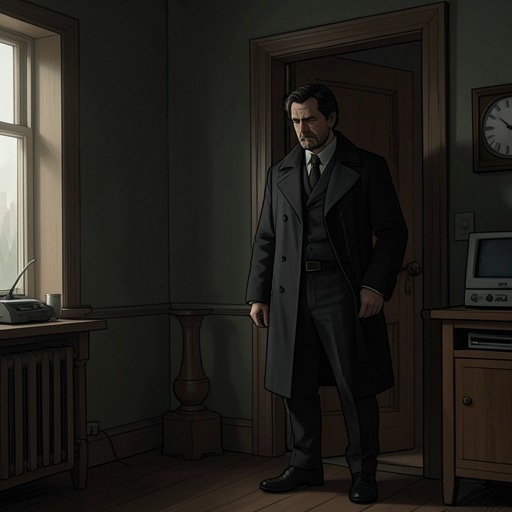
A homecoming scene gives Zofia a place in a carefully reconstructed family routine. Piet prepares a meal, sets out plates for her and the boys, and puts three red roses in a vase the couple bought at the Kosta Boda glassworks one summer. The remembered purchase and the places set for dinner give ordinary objects a shared history; his preparations make clear how strongly he wants to return to family life even when his work takes him away.
When Zofia arrives, the two embrace as they usually do. Piet thinks each time that he never wants to let go. Yet he tells her that he must travel to Warsaw for an emergency meeting and will be back the next night, a reason that conceals the larger truth of his work. She shrugs. The gesture is brief, and the scene does not explain what she makes of the excuse; its contrast with Piet’s inward intensity nevertheless places affection beside the deception that shapes their relationship.
The roses also become a small exchange between them rather than merely part of Piet’s private preparation. Zofia thanks him for the flowers, and he tells her that he loves her. His narration emphasizes how much he loves her and how intolerable even one night away has become. He contrasts this dependence with his life before Zofia, when loneliness in hotel rooms had not felt so suffocating. The passage establishes that the marriage is not simply a domestic refuge to him: it has altered his experience of solitude.
Trust and Concealment
Piet understands the household as a shared home and describes trust between himself and Zofia as reciprocal. He sits behind her while she washes dishes, thinking of the home as his, hers, and theirs. But the reassurance turns immediately uneasy: he has just lied to her. Lying is habitual for him, something he says he often considers for plausibility before consciously deciding to do it. In this instance, the lie feels reluctant and difficult to bear. The tension is therefore not between affection and indifference, but between a genuine attachment and the secrecy that prevents Zofia from fully sharing his circumstances.
The children deepen that conflict. Piet watches Hugo and Rasmus when they are feverish, kisses each on the forehead, and reflects that becoming their father changed the meaning of the life he had known before them. His memory of family is inseparable from his account of Zofia’s care and their shared home. At the same time, his work repeatedly requires explanations that he cannot give her. The evidence shows the cost of that divided life from Piet’s side, while leaving Zofia’s private understanding of the deception largely unspoken.
Distance and the Unspoken Conflict
The strain becomes more audible during a telephone call. Piet says that the meeting is continuing and asks how the boys are; Zofia answers, “Do you care?” He experiences her voice as cold and hollow. The exchange makes his stated concern collide with the effect of his repeated absences. It does not establish everything Zofia knows or the reasons for her response, but it shows that his explanations no longer preserve the reassuring intimacy he wants them to preserve.
Another return finds her lying close to their youngest son on a narrow bed, awake rather than asleep. Piet asks how the boys are, and she does not look at him. The scene offers no account of her thoughts; her silence and refusal to meet his gaze are the visible facts. Read alongside the earlier call, the moment marks a growing distance in ordinary family space: Piet has come home, but his presence does not by itself restore easy communication.
Erik Wilson presses Piet to speak to her rather than continue making excuses. Piet agrees that he will talk that evening after the boys have gone to bed and insists that he is going to finish his work. The choice places the marriage directly against the operation: he intends to proceed, even as he recognizes that the consequences for Zofia cannot be managed by another plausible story. Wilson’s urging establishes the seriousness of the conversation Piet has been postponing, without establishing what Zofia will decide once she hears him.
Piet’s Disclosure and Its Uncertain Outcome
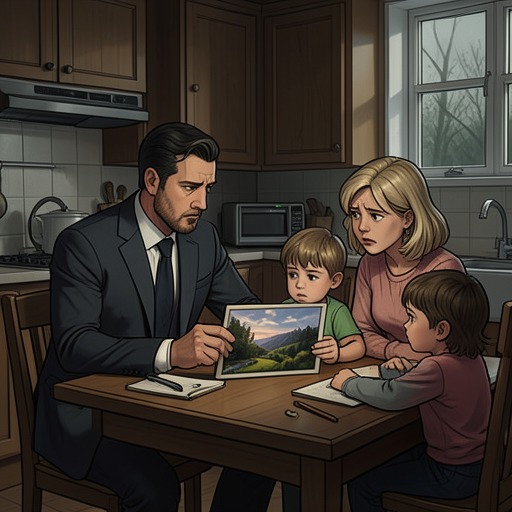
When Piet finally tries to explain, he first names what he fears losing: Zofia, Hugo, Rasmus, the house, and the roles of husband and father. He says that he has become dependent on this family life. Zofia draws herself farther into the corner of the sofa and watches him silently; Piet recognizes that she can tell he has rehearsed what he needs to say. His attempt to begin with love does not dissolve the distance between them. The account gives her response through posture and silence, not through an explanation of what she thinks.
He continues speaking over a cheap bottle of wine. When he finishes, Zofia gets up, goes into the bedroom, and turns off the light without speaking or shouting. Piet sits on the edge of the bed, aware that she is awake and looking toward his back. The silence leaves the disclosure without a clear answer: the scene records neither reconciliation nor a definitive separation. It presents the consequences of his confession as unresolved rather than supplying a response on her behalf.
Before leaving, Piet gives her a key to a safe-deposit box at a Handelsbanken branch on Kungstradgardsgatan. He explains that, if she still wants to share a life together, she should go there if he contacts her to say that the operation has begun. Inside are a brown envelope and a white envelope, with a handwritten letter telling her what to do. He is unsure whether she has taken in the instructions; her eyes seem distant to him. This practical contingency makes the uncertainty concrete: he leaves her a way to act if a future condition is met, but the scene does not say that she accepts the arrangement or follows it.
Absence and Narrative Significance
Once Piet is in prison, Zofia remains important as the person he tries not to think about. He recalls that he and Zofia stopped smoking when they saw a tiny life on a monitor, linking their shared decision to the beginning of parenthood. Later, he deliberately fights thoughts of her, particularly during the night before dawn. These details show both the intimacy of their common past and the survival strategy of suppressing it when longing threatens to overwhelm him.
That separation also returns in a dream. Piet sees Zofia running ahead of him; when he reaches for her, he cannot hold on, and she grows smaller and disappears. The dream does not reveal Zofia’s actual actions or feelings. It gives form to Piet’s fear of distance and inability to reach her, repeating in distorted form the separation already present in the marriage scenes.
Zofia’s narrative role consequently depends on a careful distinction between her importance and her limited access to the reader. Piet’s longing, his trust in her, and his fear of losing their family are directly presented; her interior response to his lies and disclosure is not. Her silence is consequential precisely because the novel does not translate it into a settled verdict. The account leaves the marriage’s future open, with Piet’s love and the damage of concealment occupying the same unresolved space.